
Taking A Fresh Look At Christianity
Humanly speaking, Christianity is an impossibility. For example, it takes a miracle to save a soul. It takes the power of God to keep those whom He saves. Thus, we can see that when we look at Christianity from our human perspective, everything begins to pile in on us and it seems so impossible.
We need to remember that our Christianity will be measured, not according to the self-satisfaction that it brought to us, but from how we earnestly contended for the faith. God rewards us for our faithfulness to Him, not our circumstantial success.
Christianity operates in reverse order. The last shall be first with God. Those who are abased shall be exalted. We fail to see the glory of this process, due to the personal mortification involved. But rest assured, we are always indebted to our Lord.
Christian legacy does not originate from those who are the esteemed of men. The example the Bible gives of one who left his mark for Christianity, was one who knew not any favorable response from men. Abel’s legacy still stands as a testimony to mankind – Hebrews 11:4. All Abel saw for his efforts of being faithful and true was the hatred that slew him. But for almost 6000 years now, the legacy of his faith has continued to make him one of God’s jewels for which he will be richly rewarded.
The kingdom of Christianity is not of this world. Therefore, Christianity is not measured by our accomplishments down here. Rather, God directs us to the reality of doing all we can to “endure” while in our pilgrimage of life down here.
Christianity results in the scourging of, rather than the crowning of, our earthly person. Not that it is bad for man, but that because of blindness, men are bad towards Christians. This, too, shall greatly enrich us in the kingdom we will inherit with Christ – Matthew 5:10-12.
As Peter surrendered to Christ’s call to the worthy and noble vocation of feeding Christ’s sheep, he was shown that in his latter day, others would “carry thee whither thou wouldest not. This spake he (Christ) signifying by what death he (Peter) should glorify God. And when he had spoken this, he saith unto him, Follow me.” – John 21:18f-19.
Paul’s Christian ministry cost him his freedom and eventually his life. But in assessing his life in full view of this, he told the elders of Ephesus, at his meeting with them at Miletus (Acts 20): (1) That he was pure from the blood of all men, having not shunned to declare all the counsel of God, (2) He knew he was not to continue, so he poured out of himself to them, that they might perpetuate the gospel to others.
Our tour of duty is but for a season. As we sense the greatness of our troubles, may it help us to realize the magnitude of the glory that awaits us after the battle is over.
Yes, “heaven will surely be worth it all.”
SHARING


Religion Minus Divine Authority
“All scripture is given by inspiration of God, and is profitable for doctrine, for reproof, for correction, for instruction in righteousness: That the man of God may be perfect, throughly furnished unto all good works.” 2 Timothy 3:16-17
The truth of God’s Word supplies enlightenment and faith. When human reasoning sets aside any part of God’s Word, this allows the cloud of deception, as was introduced to Eve in Eden (Genesis 3).
While many profess to stand for the Divine inspiration of all scripture, they fall for the reasons that abandon “all scripture” as being the standard for doctrine, reproof, correction, and instruction in righteousness.
Just as all scripture is given by Divine authority, all scripture is what sets forth God’s authority on all matters for us. To agree with the inspiration of “all scripture”, without accepting “all scripture” as the authority on God’s will for our lives, is the condition of having a form of godliness, but denying the power (authority) thereof (2 Timothy 3:5). To study “all scripture” without accepting the way of “all scripture”, is the condition of ever learning and never able to come to the knowledge of the truth (2 Timothy 3:7).
False Christianity would be exposed instantly, if the rule was applied that “all scripture” is required for true doctrine. False Christianity is able to establish itself with men, because it persuades men that not all scripture applies to us. Most take the position that truth is dispensational, i.e., that what was the truth in a former dispensation is no longer truth for our present dispensation, etc. For example, many teach that the way Jesus saved sinners, such as the thief on the cross, is different than how one becomes a Christian today. So false Christianity is built on the principle that while all scripture is given by inspiration of God, yet all scripture is not profitable for doctrine, etc.
Sad to say, many professed Baptists have fallen for the same false interpretation of the scripture. While they may not accept the false teachings on the plan of salvation that have departed from the doctrine of all scripture, they eagerly accept the departure from “all scripture” as being profitable for their doctrine on how they want to live, dress, and observe the Lord’s Day. They do so as if they have impunity (exemption) from “all scripture”, misapplying a borrowed term from the scriptures, “we’re not under the law”. They thus will no longer be reproved nor corrected unto God’s will by what “all scripture” has to say. They have limited themselves to an acceptance of only some scriptures of their choosing, while having their eyes and ears closed to what “all scripture” has to say.
Since “all scripture” must be used to establish doctrinal correctness, the departure from this principle of Divine authority is to enter the pathway of doctrinal error, that sanctions false religion. SELAH!
SHARINGWhat Makes New Testament Baptists Different?
ANSWER: The very things that make us a New Testament Baptist are what make us different.
When we look at our prototype, John the Baptist, it was what he was by God’s will and authority that made him different. John the Baptist not only served God, he was sent from and by God, identified by God, with heaven’s authority to perform his mission: “…to make ready a people prepared for the Lord,” Luke 1:17.
For a people to be made ready for the Lord, it involved:
–their responding to the preaching that they must repent, Matthew 3:2,8
–their acceptance of Christ as “the Lamb of God that taketh away the sin of the world,” John 1:29,35-37.
–that they be administered New Testament Baptist baptism, sent from heaven, (John 1:33, Acts 1:22) at the hands of the first Baptist preacher, Matthew 3:1.
Christ (who submitted to Baptist baptism to fulfill all righteousness, Matthew 3:13-17) took those whom John had prepared for Him and set them first in His New Testament Church, 1 Corinthians 12:28. It was the fact they were prepared by a ministry of Divine authority, baptized by a minister authorized and identified by God’s authority, and set in the church by the authority of Christ–that’s what made the first New Testament Baptist Church at Jerusalem different from all other religious bodies.
Christ taught that His Body, the New Testament Church He built from those apostles whom John the Baptist prepared for Him, was not a product of human making, but had come to pass, i.e. been created by the Divine authority that had brought it all to pass, see John 15:1-5. The vine with its branches exists due to the life God has given it by His authority. Whereas man cannot create life, he can only produce something that is artificial.
It was this “life” that existed in the New Testament Church that Jesus built that made it different, that made it the work of God, the same way that it was the authority of God that sent and made John the Baptist’s baptism different and sanctioned by heaven.
Today, a New Testament Baptist Church is different because it has descended from the church that Jesus built, with this same existing authority and baptism that God once delivered to the saints, having the same Head (Christ), the same authority and Biblically identifiable baptism that Jesus and the apostles had (Baptist), who were the first set in the church.
These distinctives are not subject to the arguments of men, but are rather afforded to those who accept them by faith.
With God, there is but “One Lord, one faith, one baptism.” Ephesians 4:5
SHARING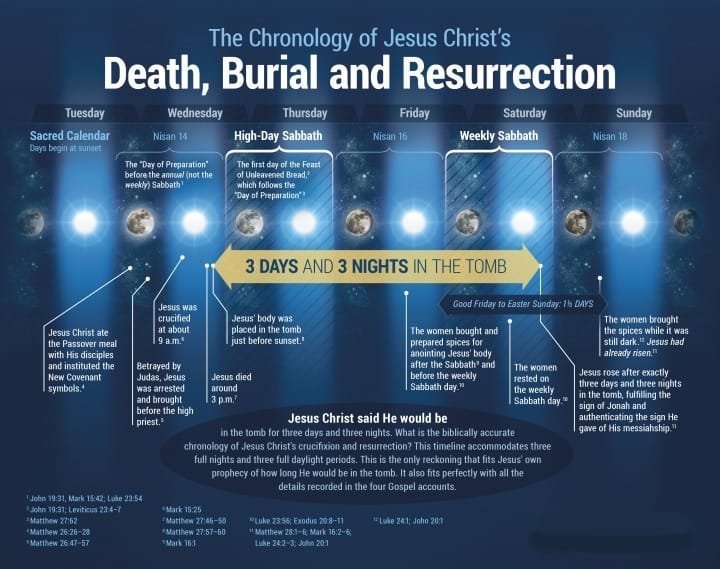


The Calendar Of Events Surrounding The Death Of Christ
Note: In Biblical days, the 24 hour daily cycle was divided into two equal parts: night and day – the night preceding the day, Genesis 1:5,8,13,19,23,31. The sun controlled the day, and the moon the night, John 11:9. In Biblical days, the day started at 6:00pm (in the evening) and ended at 6:00pm the next evening. Our days are reckoned from 12:00 midnight to 12:00 midnight.
SATURDAY: Mark 11:1-11: Jesus entered Jerusalem. The world says He entered on Palm Sunday. He entered the Temple as His custom was on the Sabbath. Mark 11:11, He returned to Bethany.
SUNDAY: Mark 11:12-19: He returns to Jerusalem. On the way, He curses the fig tree. Mark 11:15-19, He cleanses the Temple. Mark 11:19, Jesus goes back to Bethany.
MONDAY: Mark 11:20: Jesus returned to Jerusalem by the same route and sees the withered fig tree. Mark 11:27–Mark 14:1, Jesus teaches and answers questions. Mark 14:1…In 2 days (Wednesday) would be the Passover.
TUESDAY: Mark 14:12-16: The day before the Passover, the Preparation Day. The Jewish Passover began on the 14th day of the month Abib or Nisan, by killing the lamb that was caught on the 10th day of the month, Exodus 12:3-6. The Passover is a type of Christ – 1 Corinthians 5:7. The Passover lasted 7 days. The first day of the Passover (the 15th) and the last day were High Sabbaths (annual). – Leviticus 23:4-8.
WEDNESDAY: Their Wednesday began at 6:00pm…our Tuesday (see above note.) During this time, Jesus ate the Passover with His disciples, and instituted the Lord’s Supper, Mark 14:22-25. Mark 14:26-52, Tuesday evening (Wednesday Jewish time) they go out to the Garden of Gethsemane, where Christ prays and is arrested. Mark 14:53-72, The trial of Christ before the Sanhedrin, in the night hours (our Tuesday, their Wednesday.) Mark 15:1-25, The trial before Pilate and the crucifixion in the third hour of the day, which would be 9:00am Wednesday, our time. Wednesday, He is on the cross. Mark 15:33, There is darkness from the sixth to the ninth hours (12:00 noon to 3:00pm.) Mark 15:42-47, In the afternoon before 6:00pm, His death and burial, which would make it before the beginning of the next day, which was a High Sabbath (not the weekly Sabbath)…see John 19:31. So, before 6:00pm Wednesday, Christ was placed in the tomb.
THURSDAY: Matthew 27:62-66: Guards are placed at the tomb.
FRIDAY & SATURDAY: He is in the tomb. Saturday ended at 6:00pm.
SUNDAY: The tomb is visited, Matthew 28:1-7. Matthew 28:1 – as it begins to “dawn,” speaking of daylight. NOTE: Sunday (the first day of the week) had begun at 6:00pm Saturday, our time. Matthew 28:6, The tomb is already empty. He was in the tomb Wednesday, Thursday, and Friday nights…three nights. He was in the tomb Thursday, Friday, and Saturday…three days, just as He had said – Matthew 12:39-40. This is essential to have the gospel according to the scriptures – 1 Corinthians 15:1-4. He arose after 6:00pm Saturday evening, which was the Jewish first day of the week. So, we observe the first day of the week as the Lord’s Day. It is to be observed weekly on the first day of the week, rather than on an annual basis, just as the Old Testament Sabbath was observed weekly. If it were an annual observance, God would command it and it would fall on a different day of the week every year, just as any other annual holiday does…see 1 John 2:21.
SHARING
